ContactBook a call

Industries/ Logistics

Logistics software that puts the office and the road on the same page

We build driver apps, proof-of-delivery capture, customer tracking and the dashboards and integrations behind them, so dispatch knows what is happening without picking up the phone. Every drop leaves a timestamped record, and the paperwork that once took days to come back is there before the van returns to the depot.

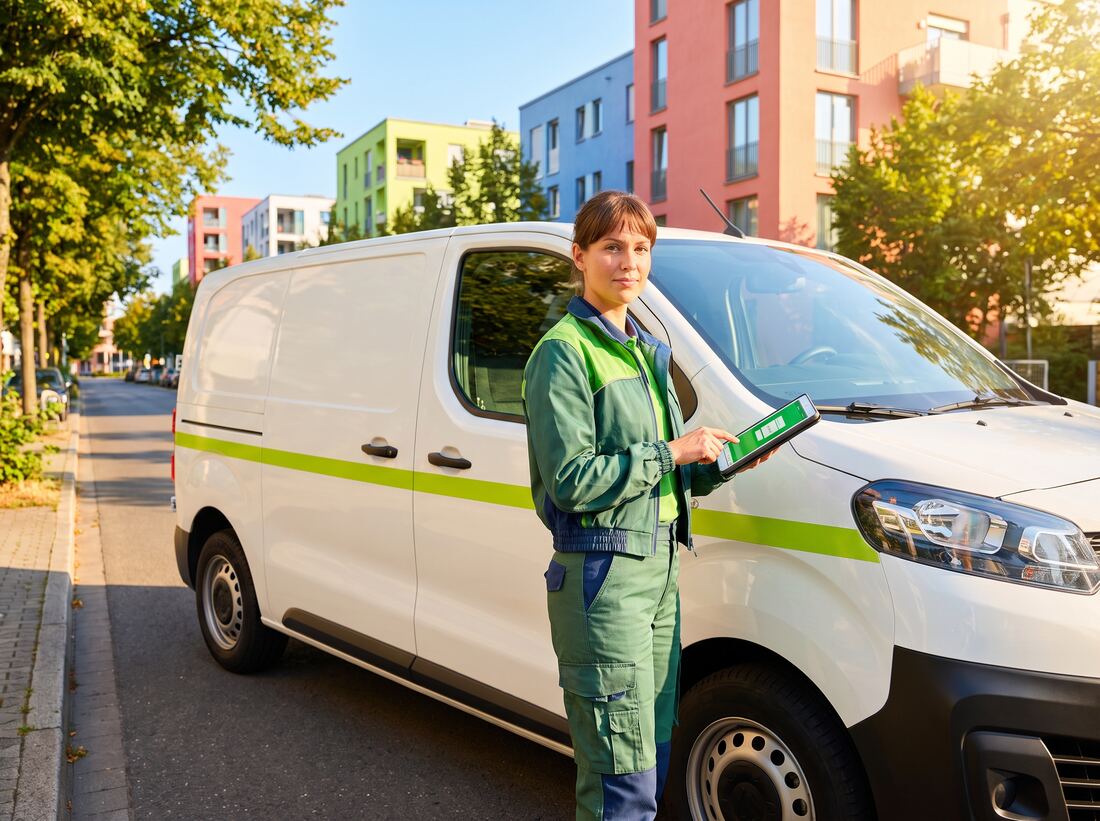
A delivery driver in a green work uniform holds a tablet beside a white van with a green stripe, parked on a tree-lined street of brightly painted apartment blocks.

Overview

Logistics, today

Logistics runs on thin margins and tight windows, and most of the people doing the work are nowhere near a desk. Drivers, warehouse staff and subcontracted hauliers each hold a piece of the picture, while the office tries to assemble it from phone calls, paper delivery notes and a transport system that only knows what someone has typed in. Customers, meanwhile, now expect the kind of live tracking the big parcel carriers offer, whether they are waiting for a pallet of building materials or a single urgent part.

Software fits wherever information currently travels by voice or on paper. A driver app replaces the manifest on a clipboard and the call to say a delivery failed. Proof of delivery becomes a photo, a signature and a location captured at the door, rather than a sheet that comes back days later. Tracking links stop customers ringing to ask. And underneath, integrations carry orders from customers' systems into yours and invoices back out again, so the office stops being the place where every job gets typed twice.

Good looks like a dispatcher who can see, without ringing anyone, which drops are done, which are running late and why. It looks like a customer dispute settled by pulling up the photo and the timestamp, an invoice raised on the day the job is finished, and a failed delivery recorded with a reason code rather than a story. It also looks like software that keeps working when the signal drops in a loading bay, and integrations that raise an alarm when they stop rather than failing silently for weeks.

The pressures

What you are up against

What operations managers, transport planners and owners of logistics firms tell us when they first get in touch.

  1. 01

    The phone never stops ringing

    Customers ring to ask where their delivery is, so we ring the driver, who is driving and cannot answer. A big part of the office day goes on relaying information that already exists somewhere, in a driver's head or on a sheet in the cab, just not anywhere we can see it.

  2. 02

    No paperwork, no invoice

    Delivery notes come back crumpled, late or not at all, and we cannot bill until we have proof the job was done. Some go missing entirely and turn into disputes weeks later, when nobody remembers what happened and the customer simply refuses to pay for that drop.

  3. 03

    Our systems do not talk

    Orders arrive from customers by email, portal and spreadsheet, and someone types them into the transport system. Then the same jobs get typed again into the accounts package. When one of the overnight imports fails, nobody notices until a customer complains or the month-end numbers refuse to add up.

  4. 04

    We never have a quiet hour

    Drivers start before dawn, the warehouse works through the night and customers book collections at weekends. There is no moment when it is safe to switch the system off, so updates get postponed until they are big and risky, and everybody holds their breath when one finally goes live.

What we build

Software for logistics

Six things we build for haulage, courier and delivery operations. Each card links to the page that explains how we approach that work.

Driver and proof-of-delivery apps

The day's manifest on the driver's phone, scanning at load and drop, photo and signature capture at the door, reason codes for failed deliveries, and everything saved safely when signal drops and synced as soon as it returns.

Read more

Customer tracking and booking

A portal where customers book collections, follow their consignments live, download proof of delivery and invoices, and see their own history, so the questions they used to phone about are answered before they think to ask.

Read more

Paperwork read automatically

Delivery notes, consignment notes, customs paperwork and supplier invoices read as they arrive, with reference numbers, signatures and handwritten notes about damage pulled out and matched to the right job, and anything unclear flagged for a person.

Read more

Operations and fleet dashboards

Drops completed, late and failed, vehicle utilisation and on-time performance by customer, route and depot, on a wallboard in the office and a phone in the yard, so problems show up during the shift rather than at month end.

Read more

Dispatch and planning tools

Internal screens for your planners: jobs allocated to vehicles and drivers, capacity and delivery windows visible at a glance, and changes pushed straight to the driver's app, replacing the whiteboard and the spreadsheet only one person can read.

Read more

Systems that talk together

Orders from customers' systems flowing into your transport software, completed jobs flowing on to your accounts, and every scheduled transfer watched, so a silent failure becomes an alert the same day rather than a month-end surprise.

Read more

What changes

From how it runs now to how it could

Five pieces of everyday logistics work, as they usually run now and as they run once the software is in place.

TodayWith the right software
Proof of delivery is a signed sheet that finds its way back to the office days later.Photo, signature, time and location are captured at the door and reach the office immediately.
Customers ring the office, the office rings the driver, and the driver cannot answer.Customers follow their delivery on a tracking link, and the office sees the same live status.
Failed deliveries are explained in a phone call and remembered differently by everyone involved.Each failed drop carries a reason code, a photo and a timestamp, ready to rebook or defend.
Orders arriving by email and spreadsheet are retyped into the transport system every morning.Orders are read, checked and created automatically, with anything unclear held for a person to review.
Invoices wait until the paperwork is found, checked and matched to the right consignment.Completed jobs with proof attached flow to the accounts system, ready to invoice the same day.

In practice

What it looks like on the ground

Three logistics examples from our service pages, following a consignment from the driver's hand, through the office paperwork, to the overnight job that moves it between systems.

01 · Logistics & last-mile delivery

Proof of delivery that ends the argument

The problem
Drivers phone in exceptions, proof of delivery is a signature on a crumpled sheet, and a customer claiming a missing consignment turns into an hour of phone calls with no evidence at either end.
What we build
A driver app with the manifest, scanning at load and drop, photo and signature capture at the door, reason codes for failed deliveries, and live status back to the office. Queuing everything when the van goes through a black spot and syncing as soon as it comes out.
What changes
Every drop carries timestamped, located evidence, failed deliveries are categorised rather than described, and disputed consignments are settled from a record instead of a memory.
More on staff & field apps
Logistics & freight

02 · Logistics & freight

Proof of delivery that files itself

The problem
Delivery notes come back signed and photographed on a phone in a lorry cab: creased, half in shadow, occasionally upside down. Each has to be matched to a consignment before the customer can be invoiced, and the ones that go missing become a credit-note argument weeks later.
What we build
Drivers' photographs are read as they upload: consignment number, date, whether a signature is present, any handwritten note about damage or a short delivery. Then matched automatically to the job. Unreadable images are rejected back to the driver while they are still at the drop, rather than discovered in the office three days later.
What changes
Invoicing happens on the day of delivery, disputes are settled by pulling up the original image in seconds, and the paperwork the office used to chase largely stops needing to be chased.
More on document intelligence
Logistics & operations

03 · Logistics & operations

The integration that stopped three weeks ago

The problem
An overnight job pushes orders into the warehouse system. It failed quietly, nobody noticed because there is no screen showing that it ran, and the discrepancy only surfaced at month end, by which point reconciling it is days of manual work and some genuinely annoyed customers.
What we build
Heartbeat monitoring on every scheduled job, so silence itself raises an alert; queue depth and error-rate dashboards for each integration; and an explicit failure path for every automation: retry, then alert a named owner, then park the record for review rather than dropping it.
What changes
A job that stops running is a notification within the hour instead of a month-end discovery, and nothing disappears silently between two systems.
More on always-on monitoring

Handled with care

The details that matter here

Logistics software is used on the move, around the clock, by people with no time to wrestle with it. These are the things we handle with particular care.

  • Working without signal

    Drivers pass through tunnels, rural roads and steel-framed warehouses where the connection drops. Our apps save every scan, photo and signature on the device first and sync when signal returns, without duplicating or losing a record. We test this deliberately in poor conditions, not just at a desk on the office wifi.

  • Releases with no quiet hour

    With drivers, warehouses and customers using the system around the clock, there is no safe time to switch it off. We release changes gradually with automatic health checks and a quick way back, and change databases in careful steps so the old and new versions can run side by side.

  • Integrations that fail loudly

    Orders, manifests and invoices move between your systems and your customers' systems all day. Every scheduled job is watched, so if one stops running a named person is alerted, and records that cannot be processed are parked for review rather than dropped. A silent failure is always the expensive kind.

  • Location and driver data

    Live location and timestamped photos are useful evidence, and they are also personal data about your drivers. We build with GDPR and similar privacy rules in mind: tracking only while drivers are on shift, clear retention periods, access limited by role, and customers seeing only the deliveries that belong to them.

Good first projects

Where to start

Good places to begin. Each one is small, useful on its own, and gives you something to show your drivers and customers early.

Guides

Worth reading first

Questions

What logistics teams ask us

Should we buy an off-the-shelf transport management system instead?

Often, yes. If your operation looks like most others of its kind, a good off-the-shelf transport management or route planning system will cover planning, dispatch and invoicing for a monthly licence, and we will tell you so. Route optimisation in particular is a specialist field where established products are hard to beat, and we would not try to rebuild one. Custom software earns its place around the edges: a driver app shaped to how your crews actually work, a customer portal in your own brand, or the integrations that make an off-the-shelf system fit everything else you run.

Will the driver app work on our existing phones?

Usually. We build for ordinary Android phones and iPhones, and for rugged devices with built-in scanners if you already use them. Drivers can use company phones or their own, though company devices make security and support simpler. The app saves everything on the device first, so a dead zone does not lose a delivery record. We test it with gloves on, in bright daylight and on poor connections, because that is how it will actually be used, and we involve a few of your drivers before anything is rolled out.

Can you connect to our customers' systems, not just ours?

Yes, and for many logistics firms that is where the real time saving is. Customers send work in every format imaginable: their own portal, an EDI feed, a spreadsheet, an email with an attachment. We build the connections that bring each one into your transport system in a consistent shape, and send status updates and proof of delivery back the way each customer wants them. Where a customer has no technical way to connect, we can read their emails and attachments instead. Every connection is monitored, so a failure gets noticed quickly.

Who looks after it once it is live?

We can, if you want us to. Logistics systems are used around the clock, so our care plans cover monitoring of the apps, servers and integrations, security updates, and response times agreed in writing. The aim is for our monitoring to spot a problem before your drivers do. If you have your own IT team, we can hand over instead, or share the work. Either way you get the source code, the documentation and the keys to everything, so you are never locked in to us.

We already have a driver app nobody likes. Can you fix it rather than start again?

Often, yes. Many driver apps fail for reasons that have little to do with the code underneath: buttons too small for gloved hands, forms that lose everything when the signal drops, too many screens between arriving and finishing a drop. We start by watching drivers use it, then decide whether redesigning the screens is enough or whether the foundations need replacing. If someone else built it and has since disappeared, we can adopt it, document it and keep it running while we improve it.

Tell us where the paperwork gets stuck

Book a free first call and walk us through a single delivery, from booking to invoice. We will point out where software would save the most phone calls and retyping, and where it simply would not be worth it.